
Case Overview
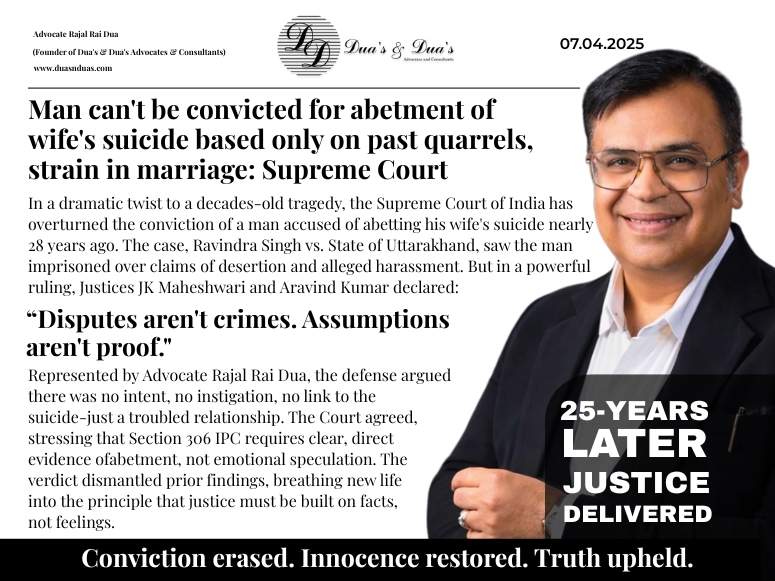
This case involved complex and emotionally sensitive allegations under Section 306 IPC, in which a woman tragically took her own life and her husband was named as the prime accused for abetment of suicide. The incident happened in the year 1997, the Family court sentenced him to seven years in prison.
As a firm that regularly handles high-profile matters, we at Dua’s & Dua’s Advocates and Consultants entrusted the defense to our senior counsel, Advocate Rajal Rai Dua, Supreme Court Criminal lawyer in Delhi. The case demanded not only technical precision but also emotional intelligence due to the gravity of the allegations. From day one, we approached this case with care ensuring our client’s rights were protected while countering the serious charges levelled against him. What followed was a strategic and principled legal battle to secure anticipatory bail before the Hon’ble Supreme Court.
Allegations Under Section 306 IPC
The abetment to suicide case stemmed from the death of a young woman who had allegedly faced domestic discord. Her family registered a criminal complaint stating that the husband subjected her to mental cruelty and emotional harassment, leading to her suicide. The FIR was lodged under Section 306 IPC, a non-bailable offense. With no prior criminal record and facing rejection of bail by lower courts, the client was in legal turmoil.
When the Supreme Court acquits in a suicide case like this, it’s due to a well-structured defense that dismantles assumptions and focuses on evidence. Advocate Dua, Supreme Court Criminal lawyer in Delhi, immediately identified key inconsistencies in the complaint and gathered material to show the absence of direct incitement or instigation, an essential element under Section 306 IPC.
Supreme Court Criminal Law Interpretation
When the case reached the Supreme Court, Advocate Dua raised critical legal questions: Does mere marital discord equate to abetment? Can accusations without proximate cause suffice for conviction under Section 306 IPC? The Bench took note of these arguments and reaffirmed that for abetment to suicide case to stand, it must be proven that the accused actively encouraged or provoked the act. The court emphasized that emotional distress alone is not enough. By granting relief, the Supreme Court acquits in a suicide case that lacked direct evidence, a powerful message reinforcing the principles of criminal justice and protecting the innocent from wrongful imprisonment.
Key Criminal Law Challenges
This case presented a host of legal complications, including:
- Whether the marital discord amounted to active instigation
- How to interpret mental cruelty in the context of criminal liability
- Whether anticipatory bail could be granted by the Supreme Court
- Ensuring the balance between justice for the victim and protection of the accused’s rights
Advocate Rajal Rai Dua, a Supreme Court criminal lawyer in Delhi known for handling sensitive matters, carefully reviewed the FIR and related documents. He noted several discrepancies and a lack of proximate cause linking our client’s actions directly to the suicide. Using his expertise as a criminal lawyer in Delhi, he crafted a legal argument that was both emotionally respectful and legally robust.
Legal Strategy by Advocate Dua
Advocate Rajal Rai Dua approached the case with clarity, compassion, and constitutional precision. His legal strategy involved:
- Filing a Special Leave Petition (SLP) to challenge the High Court’s denial of bail
- Analyzing call records, messages and witness statements to prove the lack of active abetment
- Highlighting Supreme Court precedents where bail was granted in similar circumstances
- Emphasizing the accused’s cooperation and clean record
As a trusted Section 306 IPC bail lawyer, Advocate Dua framed the arguments in a way that respected the tragedy while ensuring the law was not misused. His sharp courtroom advocacy was instrumental in turning the case in favor of our client.
Arguments in Supreme Court Bail Hearing
During the final hearing, Advocate Dua presented key points:
- The FIR was vague and emotionally charged, lacking legal substance
- No direct act or instigation by the accused could be identified
- Prior Supreme Court rulings demand strict standards for Section 306 IPC cases
- Arrest and continued prosecution without cause would violate personal liberty
The Hon’ble Bench agreed. The outcome, where the Supreme Court acquits in a suicide case based on lack of culpability, showcases the judiciary’s commitment to fairness and reasoned justice.
Significance of the Final Judgement
The Supreme Court’s verdict in this abetment to suicide case carries lasting legal significance. By acquitting the accused, the Court reaffirmed essential principles of criminal jurisprudence that protect individuals from being wrongfully prosecuted based on mere emotional allegations.
In its ruling, the Hon’ble Court clarified that:
- Criminal charges must not be based solely on emotional narratives or assumptions.
- For a conviction under Section 306 IPC, there must be concrete evidence of instigation or active encouragement to commit suicide.
- Merely strained relationships or domestic disagreements cannot automatically be equated with criminal abetment.
- Personal liberty, a constitutional right, cannot be compromised unless guilt is established beyond reasonable doubt.
- Courts must remain vigilant against the misuse of criminal law in emotionally sensitive disputes.
This judgement sets a benchmark for future cases, serving as a guide for how courts should evaluate evidence in cases involving Section 306 IPC. Our Supreme court criminal lawyer in Delhi, Advocate Rajal Rai Dua’s meticulous legal strategy ensured that justice was not derailed by emotion. The ruling stands as a victory not only for the client, but also for the fair application of criminal law in India.
Expert Legal Defense in 306 IPC Cases
Handling an abetment to suicide case under Section 306 IPC demands more than just legal knowledge, it requires a deep understanding of human psychology, social context and judicial nuance. These cases are often emotionally charged, involve grieving families, and carry the risk of irreversible damage to reputation and liberty. At Dua’s & Dua’s Advocates and Consultants, we approach every such case with sensitivity and legal rigor. Advocate Rajal Rai Dua, a highly respected Supreme court criminal lawyer in Delhi, brings over four decades of courtroom experience to cases involving serious allegations. In this matter, his ability to dissect the allegations, challenge assumptions and present facts with clarity helped turn the tide in favor of our client.